HEALTH & LONGEVITY FOR MEN
BLOG
by Coach David Ito
mental resilience
The Physiological Sigh: How to Shut Down the Stress Loop After 50
David Ito | Health & Longevity Coach, Men 50+ | MSc Public Health Nutrition
The stress doesn't turn off the way it used to. You handle the situation, walk away from the problem — and your body stays in fight-or-flight for the next three hours.
That's not weakness. That's a loop with no exit built in.
Chronic stress raises cortisol. Elevated cortisol cuts into deep sleep — the hours when your body actually repairs itself. Disrupted sleep pushes cortisol higher the next day. Higher cortisol suppresses testosterone, stacks fat around the middle, and keeps your nervous system running hot when it should be cooling down. One problem becomes four. You push through it. The loop tightens.
You're not falling apart. You're running a system that was built for acute stress — handle it, recover, move on. What most men over 50 are running instead is chronic activation with no working off-ramp. The result is familiar: wired at midnight, wide awake at 3 AM, exhausted in a way that sleep stopped fixing a few years ago.
The reason the loop is harder to exit after 50 is mechanical. The HPA axis — your body's stress regulation system — becomes less efficient at shutting cortisol down once it's been triggered. When you breathe shallowly under stress, which the fight-or-flight response demands, a specific gas exchange problem develops in your lungs. CO2 builds up in the blood. That CO2 signal tells your brain to stay alert — so the stress state continues even after the threat has passed. You're not still worried. Your chemistry just hasn't gotten the message yet.
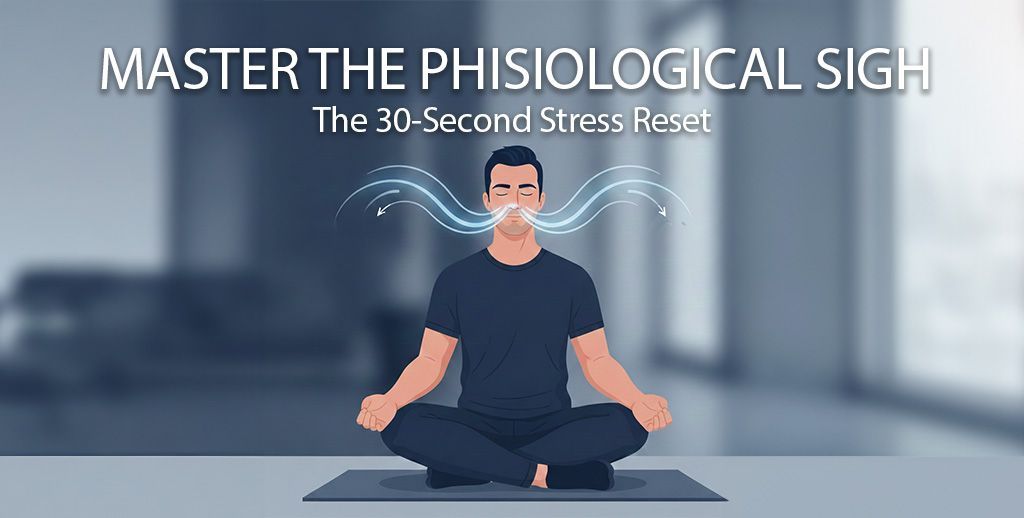
The physiological sigh addresses this directly. A full inhale through the nose, followed by a short second inhale stacked on top, re-inflates the lower lobes of the lungs completely. The extended exhale that follows activates the parasympathetic nervous system — the body's brake pedal. Heart rate slows. The CO2 clears. The alarm signal drops.
This is not just relaxation. It's a mechanical reset. Balban et al. (2023), published in Cell Reports Medicine, tested the physiological sigh against box breathing, cyclic hyperventilation, and mindfulness meditation across five weeks. The sigh produced the greatest reduction in breathing rate and the strongest improvement in mood — and required the least time to do it.
That last point is the one that matters. Most stress management tools fail men over 50 not because they don't work, but because they require twenty minutes and a quiet room that don't exist at 6 PM on a Wednesday. This runs in under 30 seconds, anywhere, without stopping what you're doing.

The Protocol Is Three Cycles
Deploy it at specific trigger points, not randomly. Before a difficult conversation. Right after a frustrating interaction. When you notice your jaw is tight and your shoulders are up near your ears. At 10 PM when you're still running hot and sleep is ninety minutes away. The physiological sigh works as a precise intervention — not a daily relaxation session. Use it when the loop activates, not on a schedule.
For a secondary layer, stack it with a 60-second tension scan: three sigh cycles, then a deliberate release from jaw to shoulders to hands. Under two minutes total. Not a meditation practice. A shutdown sequence. There is a difference.
Men who build this into the high-stress moments of their day consistently report faster sleep onset within two to three weeks. The sleep improves because the cortisol load going into the night is lower. The days sharpen because the baseline stops running so hot. Zone 2 cardio training compounds this further — it builds the aerobic base that makes your HPA axis more resilient to activation in the first place. Two protocols, same system, different angles.
You are not calmer because you relaxed. You are calmer because you gave your nervous system a working exit. At 50+, that exit is the difference between a body that recovers overnight and one that carries last Tuesday into next month.
Schedule a Free Health Strategy Call with Coach David Ito
Sources
Balban, M.Y., Neri, E., Kogon, M.M., et al. (2023). Brief structured respiration practices enhance mood and reduce physiological arousal. Cell Reports Medicine, 4(1), 100895.
Huberman, A. (2022). The Science of Breathing. Huberman Lab Podcast. Stanford University School of Medicine.
David Ito
Health & Longevity Coach
Health coach with an MSc in Public Health Nutrition and 10+ years specializing in longevity coaching for men 50+. Expert in non-pharmaceutical lifestyle medicine, personalized health transformation using 1-on-1 coaching, wearable technology, and proven accountability systems.
Ready for a healthier life?
Reclaiming yours starts with a solid plan.